
Ignis, Master of Ruin: Converting a Thousand Sons Character from the Ahriman Novels

Returning to Ruin: Ignis Master of Ruin of the Thousand Sons
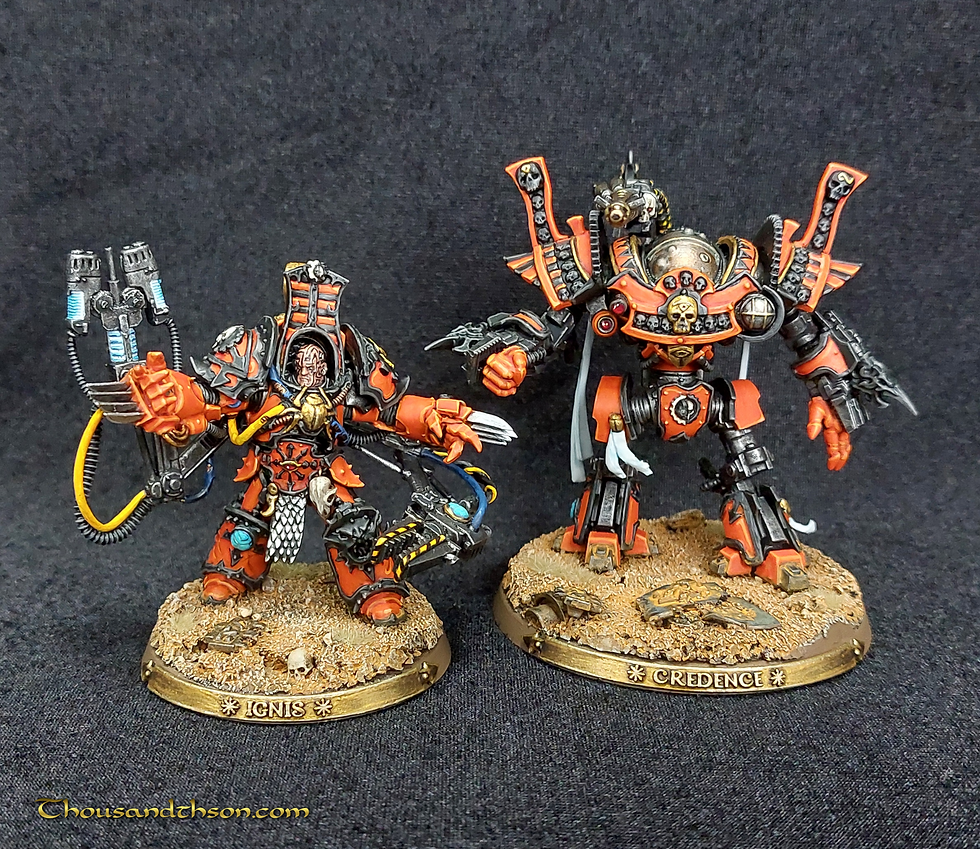
Over the last year or so, I’ve returned to my Thousand Sons army, painting infantry, tanks, and characters—usually with the next idea already lined up in the paint queue. So when I finished my Powerslave Noise Marine combo, I moved on to another project I’d been meaning to tackle for some time: Ignis, the Thousand Sons’ Master of Ruin.
Ignis and Credence are characters mentioned throughout the Ahriman novels. While Ignis appears in other Black Library material, I’ve chosen to stick closely to his descriptions in the Ahriman series, as these are the most current and consistent depictions of him.
Ignis is the Master of Ruin, a somewhat redundant title in the current setting, but nonetheless one that carries weight among Ahriman’s exiles. Without diving into spoilers, Ahriman seems to regard Ignis with genuine fondness and respect, which says a great deal given Ahriman’s disposition.
What Is a Master of Ruin?
To understand Ignis, we first need to understand the Thousand Sons’ Order of Ruin. In layman’s terms, they are the Legion’s equivalent of Techmarines: sorcerers whose talents lie in mathematics, technology, and predictive calculation rather than raw battlefield pyromancy.
Members of the Order of Ruin, known as Neuromologists, manifest psychic abilities focused on understanding the near-incomprehensible numerical underpinnings of the universe. By analysing probability, causality, and outcomes, they can predict events with frightening accuracy: knowing precisely when to strike for maximum effect, or how to position forces to minimise losses. As a result, they were often kept well away from the front lines, operating instead as planners, logisticians, and battlefield overseers.
Ignis was, and is, the master of this order and its associated school of sorcery. He later returns to Ahriman’s exiles after Ahriman takes control of Amon’s fleet. We’re told that Ignis spent many years operating as a mercenary, accompanied by his loyal Castellax-pattern battle automata, Credence.
Armour Colour and Visual Identity

I recently reread all five Ahriman novels to compile descriptions of both Ignis and Credence. One detail that stands out, and remains unexplained, is their distinctive orange armour.
At some point after being banished from the Planet of the Sorcerers, becoming a mercenary, and eventually joining Ahriman’s circle, Ignis’s armour shifts from Prospero red to a furnace orange.
(Although I suspect, as Ignis operated as a mercenary for some time, that he sold his talents to The Pyre, based purely on the shared colour scheme; right)
He never repaints his armour blue, unlike the rest of the Thousand Sons. On the tabletop, this provides a striking visual contrast and echoes the Loyalist Techmarine tradition of wearing red armour distinct from their parent Chapter’s colours.
Ignis first appears in Ahriman: Sorcerer on page 42, which is where I began tracking his physical descriptions.
Credence’s first description reads:
“The orange lacquer of its body plating gleamed in the stablights. Geometric patterns etched down to the black metal spiralled across its every inch in lines no thicker than a blade’s edge. It was an echo of the colour and marks on Ignis’s own Terminator armour; not identical, of course, never that.”
Creative Interpretation vs. Canon
Have I taken creative liberties when modelling these characters? Absolutely. Some details are never explicitly described, and unless Ignis and Credence are ever depicted visually in official media, certain elements will always remain open to interpretation. That said, the novels give us strong anchor points, and the rest can be reasonably inferred given Ignis’s role as a psychic Techmarine analogue within the Thousand Sons.
Ignis
Confirmed
Terminator armour with retractable lightning claws
Furnace-orange Terminator plate with black trim
Black electro-tattoos (electoos) on his face
Assumed
Cog iconography, reflecting historic links to the Cult Mechanicus
High crests and Egyptian themes to match Thousand Sons aesthetics
A servo-harness to support battlefield repairs and Techmarine-like functions
Credence
Confirmed
Castellax battle automata
Orange lacquered armour with geometric patterns etched into black metal across its entire frame (although I'm certainly not going to try and paint those).
Credence’s Weapon Loadouts
Credence’s armament changes over the course of the novels. Given that he’s a robot, and that Ignis would be more than capable of modifying him, it’s reasonable to assume that any weapon configuration available to a Castellax Automata would be considered canon at different points in time.
In Ahriman: Sorcerer:
“The cannon on its back shrouding the Terminators in explosions… Credence smashed his hand into the warlord’s helm. Its fingers closed with a cough of pistons, and it yanked the warlord up as the cannon on its back rotated down. It fired. Hzakatris’s head and helm vanished in a spray of explosive rounds.”
Later in the same novel:
“…as Credence triggered the flamer units bound to its wrists.”
This suggests a Mauler Bolt Cannon mounted on its back, along with wrist-mounted flamers.
By Ahriman: Eternal, however:
“The beam of darkness stabbed out from the automaton’s gun and struck Setekh in the torso.”
Here, the weapon reads more like a Darkfire Cannon. The same evolution occurs with Credence’s wrist weapons: initially described as flamers, later firing solid-shot ammunition.
One additional detail I wrestled with is the fact that Credence is explicitly described as having fingers in Ahriman: Sorcerer. The Castellax kit only includes spinning power blade arrays or vice-clamp like shock chargers. In the end, I opted to give Credence articulated hands. By this point in the narrative, it’s safe to assume much of Credence is non-standard anyway.
The Models
For Credence, I used the relatively new Heresy-era Castellax Automata kit. While it still required a fair amount of conversion, it provided a solid foundation.
Ignis was more challenging. I wanted him in Terminator armour, but I’d already used the standard Chaos Terminator Lord for another character in the army. Ignis is a centrepiece model, so I ultimately chose the Abaddon kit. The pose, proportions, and overall design do an excellent job of conveying the mass and presence of Terminator plate, making it an ideal starting point for such an important character.

Conversion Work and Key Components
As for the key conversion work, the first thing I tackled, well before the kits even arrived, was Ignis’s lightning claws. I had a few Terminator lightning claws in the bits box, but I wasn’t keen on the clenched fists of those older sculpts. They just didn’t suit the pose I had in mind for Ignis.
Luckily, I also had a pair of power fists, one for each side. I carefully cut out the palms and fingers, shaped them to size, and then removed the “fingers” from the lightning claws using a Dremel. It was a bit of a faff, but one that I think paid off in the end, giving the claws a much more open and expressive look.
The rest of the model was refined with careful Green Stuff work, adding cog motifs, scarabs, and other small details to reinforce Ignis’s role and aesthetic.
The most time-consuming element by far, however, was the servo-harness. I didn’t have anything suitable in the bits box, so it had to be scratch-built from a mix of spare components, plasticard, and Green Stuff tubing. Did I go overboard with the cables? Maybe. But at the end of the day, this is Warhammer, and the rule of cool always wins.
Converting Credence
With Credence, one of the bigger challenges was “chaosing up” an otherwise very clean, very Imperial model. At least with Ignis, I was starting from a Chaos kit and building a Chaos character. The Castellax Automata, on the other hand, lacks almost all of the visual cues we associate with Chaos models.
To address this, I added trim to several sections using Green Stuff, along with a scattering of smaller details to help tie Credence visually into the rest of the army. The goal was subtle corruption rather than overt mutation, something that felt deliberate and engineered, rather than warped.
Some of the key armour pieces came from a Necrosphinx torso I found in my bits box. I genuinely couldn’t tell you where it came from. I bought a Necrosphinx years ago, but that kit is complete, and I’ve already used any obvious spare parts elsewhere. Somehow, though, this torso existed.
Whatever its origin, it proved ideal. I was able to carefully take it apart and repurpose it into a new front plate and shoulder guards for Credence, giving the model a heavier, more ornate silhouette while still feeling mechanically coherent.

and as always, I order my name plates from Versatile Terrain.
Painting the Models
For painting, I opted for a black basecoat, mainly to support the dark iron and black trim. I’d usually undercoat my Thousand Sons in grey, but I didn’t fancy chasing down recessed grey areas with a brush, especially when any missed spots would stand out starkly against the darker finished scheme.
That said, this may have been a mistake.
What I hadn’t fully appreciated beforehand is that orange is apparently a very difficult colour to paint, right up there with yellow. As I worked through these models, it dawned on me that, aside from painting flames, I don’t think I’d ever actually painted orange before. It was a bit of a rude awakening.
I started with a base of Skrag Brown over the black undercoat, followed by a couple of layers of Troll Slayer Orange, then a wash of Fuegan Orange. At that stage, the finish was still noticeably streaky, so I kept building it up with additional thin layers of Troll Slayer Orange.
In the end, I think the orange sections ended up with around seven thin layers in total.
For highlights, I mixed Troll Slayer Orange with Lugganath Orange, edging the armour panels before painting the brightest points with neat Lugganath. The whole area was then tied together with a final wash of Casandora Yellow, which helped enrich the tone and smooth some of the transitions.
I had originally planned to paint a full unit of Chaos Marines as The Pyre, as Ignis’s personal retinue, but after this experience… I’m not so sure.
And with that, another character joins the Thousand Sons along side a Model of the Month Servitor who I thought worked well alongside the pair.
Right Shoulder pad Ignis' face tattoos Ignis' left shoulder pad
Ignis
One detail I was particularly pleased to include was the cobra-shaped cable outlet on his back. The Order of Ruin’s icon is a striking cobra, so finding this piece in my bits box felt like a perfect fit.

And if you're interested in seeing the rest of my Thousand Son's army, the blog post for them can be found below.


Comments